

Posted on September 4, 2026 in Building Maintenance
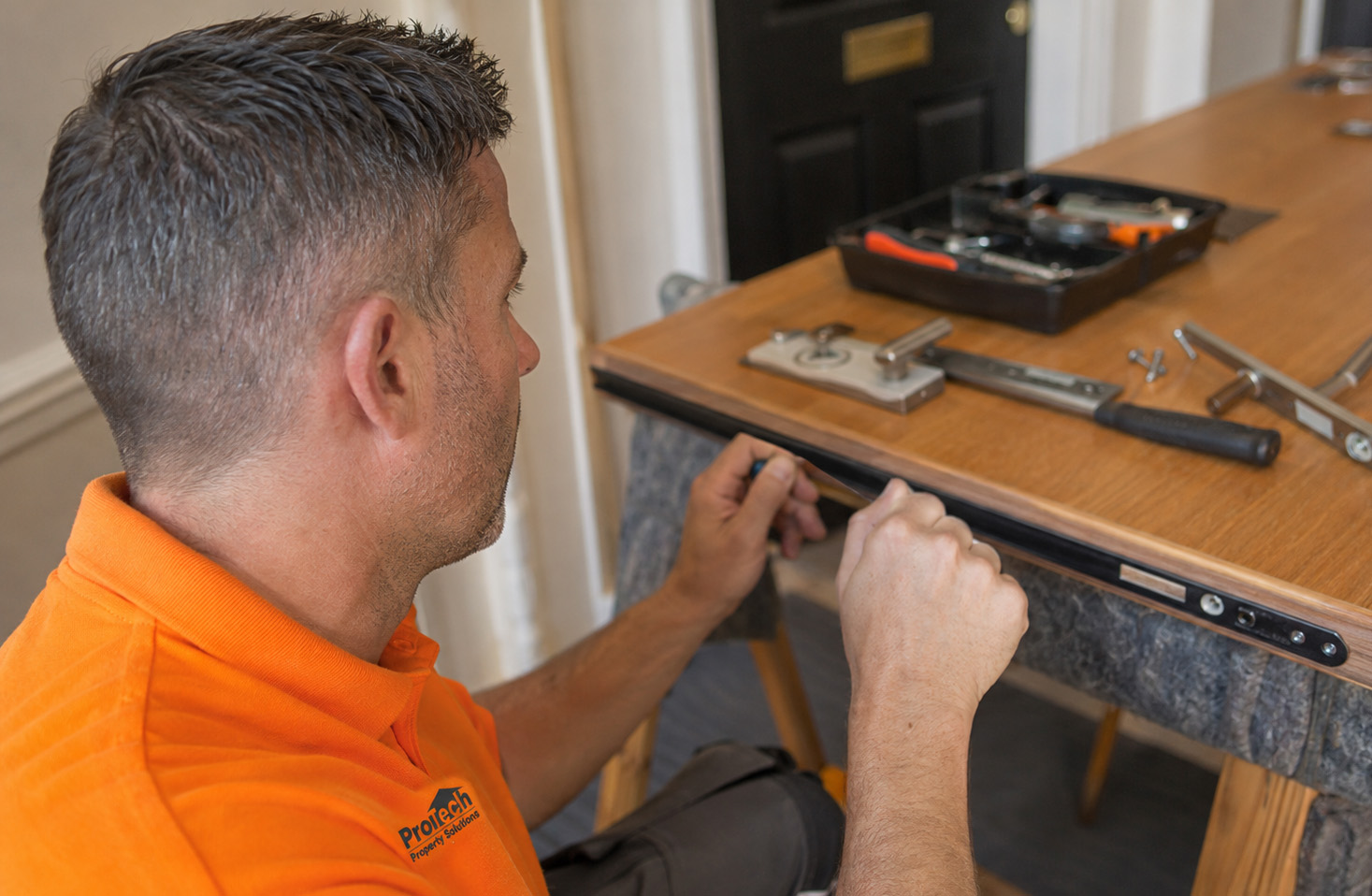
Don’t replace fire doors unnecessarily. Discover when repair is the safer, more cost-effective choice, and how Protech’s Fire Door Compliance Department keeps you legally compliant.
Fire doors are one of the most important — and most overlooked — elements of a building’s fire safety strategy. They hold back smoke and flames, protect escape routes, and buy vital time in an emergency. Yet when a fire door is damaged, many property managers assume the only option is a full replacement.
In most cases, that assumption is wrong — and it can be an expensive one.
Page Contents
The Common Misconception
A scratched panel, a worn intumescent seal, a self-closer that no longer shuts the door fully: these are typical, everyday issues, not reasons to condemn an entire door. Fire doors are engineered assemblies made up of the leaf, frame, seals, hinges, glazing and ironmongery working together. When one component fails, it’s usually that component — not the whole assembly — that needs attention.
Unnecessary replacement doesn’t just waste budget. It also generates avoidable disruption for residents and tenants, adds to landfill, and, if the replacement isn’t specified and fitted correctly, can actually leave a building less compliant than before the work started.
When Repair Is the Right Call
A qualified inspector can usually resolve the following without replacing the door:
- Worn or missing intumescent and cold smoke seals
- Faulty or poorly adjusted door closers
- Damaged hinges, handles or other ironmongery
- Minor surface damage that doesn’t compromise the core
- Gaps around the frame exceeding tolerance
- Signage that’s missing or non-compliant
Provided the door leaf and frame themselves remain structurally sound and correctly certified, these repairs restore full fire performance at a fraction of the cost of replacement.
When Replacement Genuinely Is Necessary
Repair isn’t always appropriate, and a responsible property manager needs to know the difference. Replacement is usually the right decision where there is:
- Structural damage to the door leaf, such as splitting, warping or significant impact damage
- No certification or evidence of the door’s fire rating
- Incompatible or unknown modifications that have compromised the door’s performance
- Persistent failure of the same fault despite repeated repair
A proper inspection, carried out by someone who understands both the regulations and the engineering behind fire door assemblies, is the only reliable way to tell which category a door falls into.
What the Law Requires
Fire door duties sit within a well-established legal framework. The Regulatory Reform (Fire Safety) Order 2005 places a duty on the “Responsible Person” for a building — typically the owner, employer, or managing agent — to ensure fire doors are properly maintained as part of an ongoing fire risk assessment.
The Fire Safety (England) Regulations 2022, in force since January 2023, went further for multi-occupied residential buildings. Responsible Persons must now provide residents with information about the importance of fire doors, and in buildings over 11 metres, they must carry out quarterly checks of fire doors in communal areas and make best endeavours to check flat entrance doors annually.
None of this legislation requires wholesale replacement of a fire door simply because a fault is found. What it requires is that faults are identified, assessed and properly rectified — and that the work is documented, so there’s a clear audit trail if it’s ever needed.
How Protech’s Fire Door Compliance Department Helps
Our Fire Door Compliance Department was set up to give property managers exactly this: a proportionate, properly documented approach to fire door maintenance, rather than a default to replacement.
Our service includes:
- Detailed fire door inspections against current legislation and BS 8214 guidance
- Clear reporting that distinguishes genuine repair needs from replacement needs
- Prompt, competent repairs carried out by trained engineers
- Full documentation for your compliance records and audit trail
- Ongoing inspection scheduling, so issues are caught early and cheaply
The result is a building that stays compliant, a budget that isn’t spent unnecessarily, and residents who experience less disruption from remedial works.
We’re BM TRADA Accredited
Protech Property Solutions holds BM TRADA accreditation for our fire door work.
BM TRADA is one of the UK’s leading independent, UKAS-accredited certification bodies for passive fire protection. Its Q-Mark schemes cover the manufacture, installation and maintenance of fire doors, and accreditation isn’t a one-off badge — it means our processes, technical knowledge and on-site work are independently audited on an ongoing basis, with certification withdrawn if standards aren’t maintained.
In practical terms, this accreditation gives you:
- Verified competence. Our engineers work to nationally recognised technical standards, not just in-house practice.
- Independent oversight. Our work is regularly audited by BM TRADA, not simply self-certified.
- A clear audit trail. Every inspection and repair is documented to a standard that satisfies Responsible Persons, insurers and enforcing authorities.
- Genuine due diligence. Appointing an accredited contractor is one of the clearest ways a Responsible Person can demonstrate they’ve taken reasonable steps to comply with their legal duties.
For our clients, it means that when we tell you a door can be safely repaired rather than replaced, that judgement is backed by an independently audited standard — not just our word.
Talk to Protech
If you’re responsible for fire door compliance across one property or a whole portfolio, we’d be glad to help you get the balance right between safety, compliance and cost.
Protech Property Solutions 📞 01707 644 601 ✉️ info@protechpropertysolutions.co.uk 🌐 www.protechpropertysolutions.co.uk
This article is provided for general information and does not constitute legal advice. Responsible Persons should always refer to current legislation and seek a professional fire risk assessment specific to their building.
Categories
- Building Maintenance
- Cleaning
- Electrical
- Gardening
- General Info
- Our Service
- Pest
- Security
- Uncategorized
- Waste Solutions
Archive
- September 2026
- August 2026
- July 2026
- April 2026
- February 2026
- January 2026
- November 2025
- October 2025
- September 2025
- July 2025
- June 2025
- May 2025
- April 2025
- March 2025
- February 2025
- January 2025
- December 2024
- November 2024
- October 2024
- September 2024
- August 2024
- July 2024
- June 2024
- May 2024
- April 2024
- March 2024
- February 2024
- January 2024
- December 2023
- November 2023
- August 2023
- April 2023
- February 2023
- January 2023
- December 2022
- November 2022
- October 2022
- September 2022
- August 2022
- July 2022
- June 2022
- May 2022
- April 2022
- March 2022
- February 2022
- January 2022
- December 2021
- October 2021
- September 2021
- August 2021
- July 2021
- June 2021
- May 2021
- April 2021
- March 2021
- February 2021
- January 2021
- December 2020
- November 2020
- October 2020
- September 2020
- August 2020
- July 2020
- June 2020
- May 2020
- April 2020
- March 2020
- February 2020
- January 2020
- December 2019
- November 2019
- October 2019
- September 2019
- August 2019
- July 2019
- June 2019
- May 2019
- April 2019
- March 2019
- February 2019
- January 2019
- December 2018
- November 2018
- October 2018
- September 2018
- August 2018
- July 2018
- June 2018
- May 2018
- April 2018
- March 2018
- February 2018
- January 2018
- December 2017
- November 2017
- October 2017
- September 2017
- August 2017
- July 2017
- June 2017
- May 2017
- April 2017
- March 2017
- February 2017
- January 2017
- December 2016
- November 2016
- October 2016
- September 2016
- August 2016
- July 2016
- June 2016
- May 2016
- April 2016
- March 2016
- February 2016
- January 2016
- December 2015
- November 2015
- October 2015
- September 2015
- August 2015
- July 2015
- June 2015
- May 2015
- April 2015
- March 2015
- February 2015
- January 2015
- October 2014
- May 2013
- April 2013
- November 2011
- September 2011
- June 2011
- January 2011
- December 2010
- November 2010