

Posted on July 17, 2026 in Building Maintenance
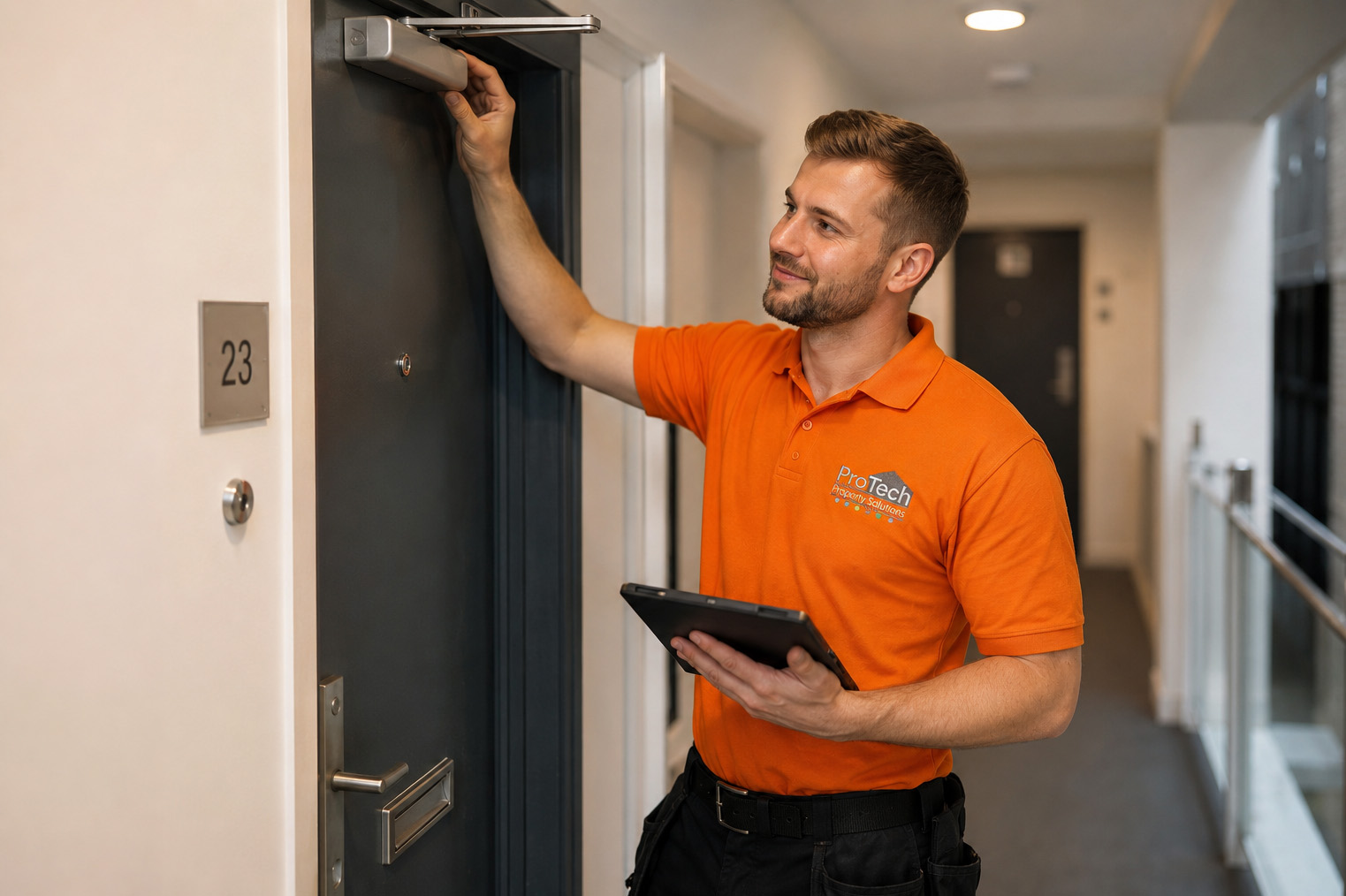
Flat entrance doors are a vital part of the fire protection within a block of flats. They are designed to help prevent fire and smoke from spreading from an individual flat into communal corridors, staircases and escape routes.
However, one question frequently causes confusion among freeholders, managing agents, landlords and leaseholders:
Who is responsible for ensuring a flat entrance fire door is compliant?
The answer depends partly on the building’s management arrangements and the wording of the lease. However, responsibility for managing the overall fire risk will normally rest with the building’s Responsible Person.
Page Contents
What Is a Responsible Person?
Under the Regulatory Reform (Fire Safety) Order 2005, the Responsible Person is the individual or organisation that has control of the building’s communal areas.
In a residential block, this will commonly be the:
- freeholder or building owner;
- landlord;
- residents’ management company;
- right-to-manage company; or
- managing agent, depending on the responsibilities they have accepted.
The Responsible Person must arrange and record a suitable fire risk assessment and take appropriate steps to manage fire risks within the areas covered by the legislation.
Government guidance states that the Fire Safety Order applies to the common parts of buildings containing two or more domestic premises and places duties on those who control those areas.
Are Flat Entrance Doors Included?
Yes.
The Fire Safety Act 2021 clarified that flat entrance doors opening into communal areas are within the scope of the Fire Safety Order.
This means that flat entrance doors must be considered as part of the building’s fire risk assessment, even though the inside of an individual flat is generally treated as a domestic premises.
The Responsible Person must therefore consider whether these doors provide suitable protection to communal escape routes.
Who Must Arrange Inspections?
For multi-occupied residential buildings in England with storeys more than 11 metres above ground level, the Fire Safety (England) Regulations 2022 require the Responsible Person to use best endeavours to undertake:
- annual checks of flat entrance fire doors; and
- quarterly checks of fire doors within communal areas.
Communal doors may include doors protecting staircases, corridors, electrical cupboards, risers, plant rooms and other fire-resisting compartments.
The Responsible Person should also keep records of the steps taken to inspect flat entrance doors. Where access has not been obtained, the attempts made to contact the resident and arrange access should be documented.
What About Smaller Blocks?
The specific Regulation 10 requirement for annual flat entrance door checks applies to residential buildings above 11 metres.
However, this does not mean that flat entrance doors in smaller blocks can be ignored.
Flat entrance doors in all multi-occupied residential buildings should still be considered within the building’s fire risk assessment. The Responsible Person must ensure that appropriate fire precautions are maintained and that significant defects are addressed.
A competent fire risk assessor may recommend a suitable inspection programme based on factors including:
- the height and layout of the building;
- the age and condition of the doors;
- the building’s evacuation strategy;
- the vulnerability of residents;
- previous alterations or damage; and
- the findings of earlier inspections.
Is the Leaseholder Responsible?
The leaseholder may be responsible for maintaining, repairing or replacing their individual flat entrance door. This will depend on the wording of the lease.
Some leases treat the entrance door as part of the flat. Others place responsibility for the door, frame or external appearance with the freeholder or management company.
The lease should therefore be checked before deciding who is contractually responsible for arranging or paying for remedial work.
However, an important distinction must be made between:
responsibility for managing compliance, and
responsibility for paying for the repair.
Even where a leaseholder must maintain or pay for their door, the Responsible Person still has a duty to consider the door as part of the building’s overall fire-safety arrangements.
A defective door should not simply be removed from the compliance programme because the leaseholder may be financially responsible. The defect should be recorded, communicated and followed through until an appropriate resolution has been achieved.
What Should Be Checked?
A flat entrance fire door inspection should consider the complete doorset, not simply the door leaf.
Depending on the door and the scope of the inspection, checks may include:
Door and frame condition
The door leaf and frame should be free from serious damage, warping, splitting or unauthorised alterations that could affect their fire performance.
Self-closing device
The door should close fully into its frame from different opening positions without assistance. A fire door that remains partly open cannot provide its intended protection.
Gaps around the door
Gaps between the door leaf and frame should be checked for consistency and suitability. Excessive gaps may allow smoke and fire to pass through prematurely.
Hinges and ironmongery
Hinges should be secure, suitably fixed and appropriate for the weight and purpose of the door. Locks, latches and other components should not prevent the door from closing correctly.
Fire and smoke seals
Intumescent and smoke seals should be present where required, correctly positioned and free from significant damage, paint contamination or missing sections.
Glazing
Any fire-resisting glazing and its retention system should be inspected for damage, movement or unsuitable replacement.
Letterplates and viewers
Letterplates, spyholes and other items passing through the door should be suitable for use within a fire-resisting doorset.
Unauthorised alterations
Additional locks, pet flaps, ventilation grilles, replacement glazing and other alterations can compromise a fire door if unsuitable components or installation methods have been used.
Common Flat Door Failures
Some of the most frequently identified flat entrance door defects include:
- missing, disconnected or ineffective self-closers;
- excessive gaps around the door;
- damaged or missing fire and smoke seals;
- loose hinges or unsuitable screws;
- doors failing to latch or close fully;
- damaged frames or door leaves;
- unsuitable letterplates;
- non-fire-rated glazing;
- holes left by removed ironmongery;
- unauthorised replacement doors; and
- alterations that cannot be supported by suitable evidence.
A door may look substantial and still contain defects that prevent it from performing properly during a fire.
Must Every Door Be Replaced?
No.
Identifying a defect does not automatically mean that the complete doorset must be replaced.
Depending on the door’s construction, condition and available evidence, it may be possible for a competent contractor to complete compliant remedial work. This could include adjusting the door, repairing the frame, replacing seals, installing suitable ironmongery or correcting the self-closing device.
However, replacement may be necessary where:
- the door is badly damaged;
- the doorset has been significantly altered;
- its likely fire performance cannot be established;
- suitable repairs cannot be completed;
- certification or supporting evidence is required; or
- replacement is recommended by the fire risk assessor or another competent professional.
The correct solution should be based on evidence and professional judgement rather than appearance alone.
Why Record Keeping Matters
A compliant fire-door programme should create a clear audit trail.
Records should show:
- which doors were inspected;
- when each inspection took place;
- who completed the inspection;
- what defects were identified;
- the risk or priority assigned to each defect;
- whether access was obtained;
- what remedial work was recommended;
- when repairs were completed; and
- whether the completed work was checked.
Good records help Responsible Persons demonstrate that they are actively managing fire safety rather than reacting only when a serious problem arises.
They also help property managers plan budgets, prioritise higher-risk defects and communicate effectively with residents and leaseholders.
Residents Also Have Responsibilities
Residents play an important role in maintaining fire-door safety.
They should be encouraged to:
- allow reasonable access for inspections;
- report faults or damage promptly;
- avoid disconnecting self-closing devices;
- never wedge a flat entrance fire door open;
- obtain permission before replacing or altering the door; and
- use competent contractors for authorised work.
The Fire Safety (England) Regulations also require Responsible Persons in multi-occupied residential buildings to provide residents with information about the importance of fire doors.
Clear communication can prevent well-intentioned alterations from compromising the building’s fire precautions.
Choosing a Competent Contractor
Fire door compliance requires more than completing a basic visual checklist. The organisation carrying out inspections, repairs or installations should be able to demonstrate that its personnel have the appropriate knowledge, training, experience and qualifications for the work they undertake.
When appointing a fire door contractor, property managers and Responsible Persons should consider whether the company can provide evidence of:
- Relevant fire door inspection, installation or maintenance training
- Recognised industry qualifications appropriate to the individual’s role
- Experience working with flat entrance and communal fire doors
- Knowledge of fire-resisting doorsets, smoke control and compatible components
- Understanding of manufacturer instructions and supporting test evidence
- Suitable insurance, quality-control procedures and record keeping
- Ongoing refresher training and competence assessment
- Independent third-party certification, where applicable
It is important to distinguish between the different types of fire door work. An individual may be qualified to inspect fire doors but may not necessarily be competent to carry out remedial works or install a replacement doorset. Likewise, an experienced installer should not automatically be assumed to be qualified to complete detailed compliance inspections.
Clients should therefore check that the contractor and the individual operative are competent for the specific task being commissioned.
Third-party certification schemes, such as BM TRADA Q-Mark, provide additional assurance by independently assessing areas such as staff competence, installation or maintenance procedures, quality management, traceability and ongoing compliance.
Protech Property Solutions is BM TRADA Q-Mark third-party certified for fire door installation and maintenance. This helps provide our clients with confidence that qualifying works are carried out by trained personnel under independently audited procedures.
Where defects are identified, remedial works should be completed using suitable materials, compatible components and appropriate repair methods. The completed work should also be clearly documented so that the Responsible Person has a reliable compliance audit trail.
How Protech Can Help
Protech Property Solutions supports property managers, freeholders and landlords throughout London and the Home Counties with practical fire-door compliance services.
We are BM TRADA Q-Mark third-party certified for fire door installation and maintenance, providing clients with added confidence that our work is carried out by trained personnel in accordance with recognised procedures, technical requirements and quality-control standards.
Our Fire Door Compliance Department can assist with:
- flat entrance fire-door inspections;
- communal fire-door inspections;
- photographic condition reports;
- defect schedules;
- remedial recommendations;
- fire-door maintenance and repairs;
- fire-door upgrades;
- replacement doorsets;
- compliance labelling;
- inspection records; and
- ongoing planned maintenance programmes.
Our aim is to make fire-door compliance easier to understand, manage and demonstrate.
Rather than simply identifying defects, we help clients create a clear route from inspection through to remedial completion and ongoing compliance.
Protect Your Building
Responsibility for flat entrance door compliance should never be left unclear.
The Responsible Person must ensure that flat entrance doors are considered within the building’s fire-safety arrangements. The lease may determine who must arrange or pay for particular repairs, but this does not remove the need to identify, document and manage defects.
A structured inspection and maintenance programme helps protect residents, communal escape routes and the organisation responsible for managing the building.
For professional advice or assistance with your flat entrance fire doors, contact Protech Property Solutions.
Telephone: 01707 644 601
Email: info@protechpropertysolutions.co.uk
Website: www.protechpropertysolutions.co.uk
This article provides general information relating principally to fire-safety requirements in England. It is not legal advice. Different legislation and guidance apply in Scotland, Wales and Northern Ireland.
Categories
- Building Maintenance
- Cleaning
- Electrical
- Gardening
- General Info
- Our Service
- Pest
- Security
- Uncategorized
- Waste Solutions
Archive
- October 2026
- September 2026
- August 2026
- July 2026
- April 2026
- February 2026
- January 2026
- November 2025
- October 2025
- September 2025
- July 2025
- June 2025
- May 2025
- April 2025
- March 2025
- February 2025
- January 2025
- December 2024
- November 2024
- October 2024
- September 2024
- August 2024
- July 2024
- June 2024
- May 2024
- April 2024
- March 2024
- February 2024
- January 2024
- December 2023
- November 2023
- August 2023
- April 2023
- February 2023
- January 2023
- December 2022
- November 2022
- October 2022
- September 2022
- August 2022
- July 2022
- June 2022
- May 2022
- April 2022
- March 2022
- February 2022
- January 2022
- December 2021
- October 2021
- September 2021
- August 2021
- July 2021
- June 2021
- May 2021
- April 2021
- March 2021
- February 2021
- January 2021
- December 2020
- November 2020
- October 2020
- September 2020
- August 2020
- July 2020
- June 2020
- May 2020
- April 2020
- March 2020
- February 2020
- January 2020
- December 2019
- November 2019
- October 2019
- September 2019
- August 2019
- July 2019
- June 2019
- May 2019
- April 2019
- March 2019
- February 2019
- January 2019
- December 2018
- November 2018
- October 2018
- September 2018
- August 2018
- July 2018
- June 2018
- May 2018
- April 2018
- March 2018
- February 2018
- January 2018
- December 2017
- November 2017
- October 2017
- September 2017
- August 2017
- July 2017
- June 2017
- May 2017
- April 2017
- March 2017
- February 2017
- January 2017
- December 2016
- November 2016
- October 2016
- September 2016
- August 2016
- July 2016
- June 2016
- May 2016
- April 2016
- March 2016
- February 2016
- January 2016
- December 2015
- November 2015
- October 2015
- September 2015
- August 2015
- July 2015
- June 2015
- May 2015
- April 2015
- March 2015
- February 2015
- January 2015
- October 2014
- May 2013
- April 2013
- November 2011
- September 2011
- June 2011
- January 2011
- December 2010
- November 2010