

Posted on September 7, 2026 in Building Maintenance
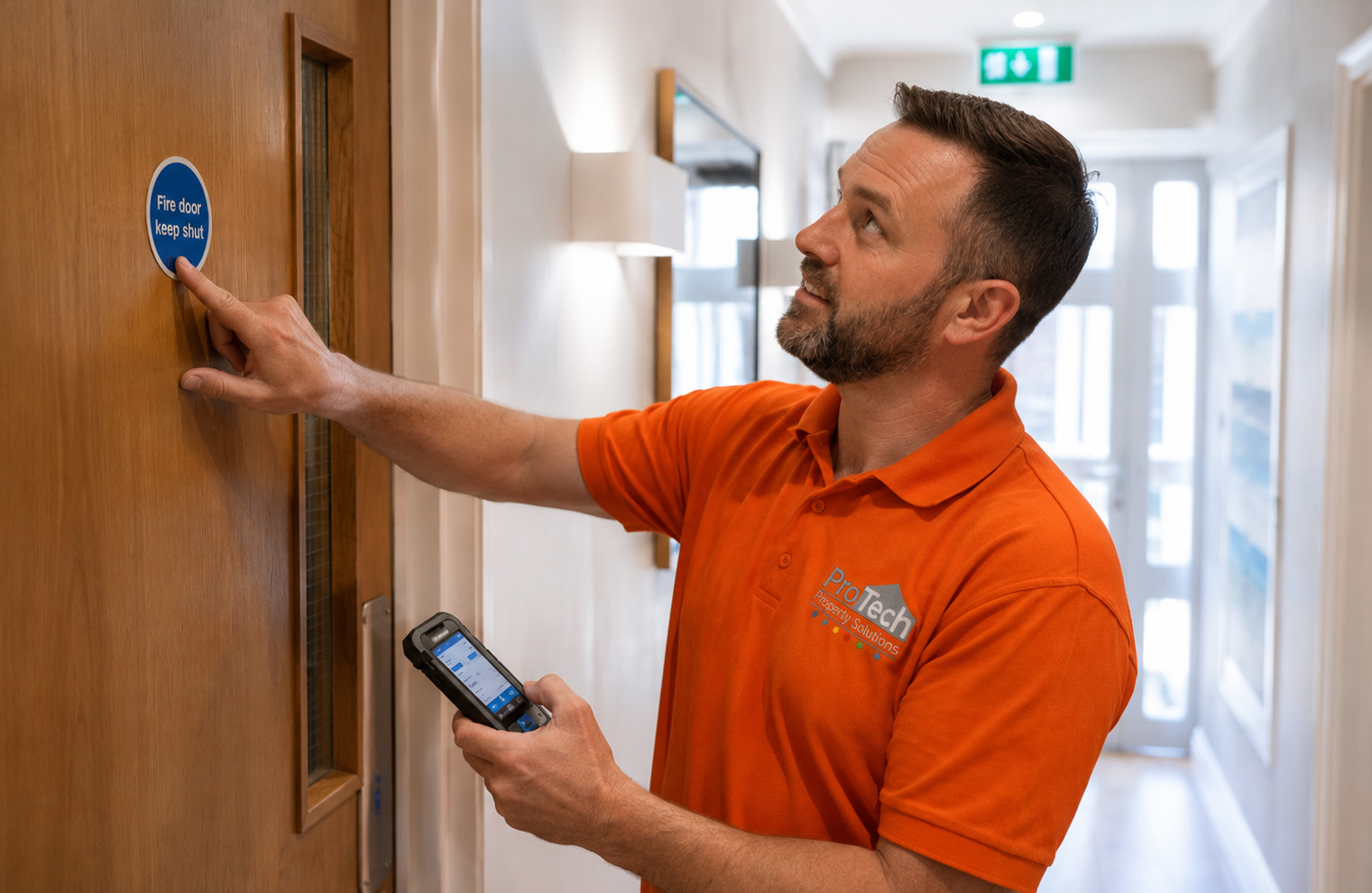
Fire door compliance is not demonstrated by an inspection sticker or a contractor’s invoice alone. Property managers should be able to produce a clear, traceable record showing that every relevant fire door has been identified, inspected, maintained and, where necessary, repaired by competent people.
Well-maintained records help protect residents, support the Responsible Person in meeting their legal duties and provide evidence to clients, fire and rescue authorities, insurers and auditors. They also make future inspections more efficient by showing the history and condition of each door.
This guide explains what a robust fire door compliance record should contain and how property managers can create a reliable audit trail.
Page Contents
Why fire door records matter
Fire doors are an important part of a building’s passive fire protection system. When correctly specified, installed and maintained, they help contain fire and smoke, protect escape routes and provide occupants with valuable time to reach safety.
However, a fire door can be compromised by relatively small defects, including:
- Excessive gaps around the door leaf
- Damaged or missing intumescent and smoke seals
- Defective self-closing devices
- Incorrect hinges, locks or other ironmongery
- Damage to the door leaf or frame
- Unapproved alterations
- Poor installation or unsuitable repairs
- Doors being wedged or held open without an appropriate device
Under the Regulatory Reform (Fire Safety) Order 2005, the Responsible Person must ensure that fire precautions are properly maintained. The Fire Safety Act 2021 clarified that these responsibilities extend to flat entrance doors opening onto the common parts of multi-occupied residential buildings.
Changes introduced in October 2023 also require Responsible Persons to record their fire risk assessment in full and document their arrangements for planning, organising, controlling, monitoring and reviewing fire safety measures. Good fire door records form an important part of this evidence. Further information is available in the Government’s guide for people with duties under fire safety legislation.
For multi-occupied residential buildings in England where the top storey is more than 11 metres above ground level, the Fire Safety (England) Regulations 2022 require the Responsible Person to:
- Check fire doors in communal areas at least every three months.
- Use best endeavours to check flat entrance fire doors at least every 12 months.
These prescribed inspection frequencies do not replace the wider obligation to keep fire doors in efficient working order. A fire risk assessment may identify that more frequent checks are appropriate because of the building’s use, condition, occupancy or history of damage.
1. Maintain a complete fire door register
A fire door register should provide a central record of every fire door for which the property manager or Responsible Person is responsible.
Each door should be given a unique reference number that remains with it throughout its service life. The register should record, where known:
- The door’s unique identification number
- Building name and full address
- Floor, area and precise location
- Whether it is a communal, riser, plant room, escape-route or flat entrance door
- Intended fire-resistance rating, such as FD30 or FD60
- Whether smoke control is required, for example FD30S
- Door manufacturer and product reference
- Installation date
- Certification label, plug or identification markings
- Date of the most recent inspection
- Current compliance status
- Outstanding actions and target completion dates
The register should be treated as a live document. Changes to a door, completed repairs, replacement components and subsequent inspections should all be added without removing the historical information.
A list that simply states “30 doors inspected” is not sufficiently traceable. A competent third party should be able to identify each door, find it within the building and review its individual compliance history.
2. Retain detailed inspection reports
Every inspection should result in a written report. The report should identify who completed the inspection, when it took place, what was examined and what was found.
A suitable inspection record will normally include:
- Property and door reference
- Inspection date and time
- Inspector’s name, company and relevant competence
- Door type and intended fire performance, where established
- Condition of the door leaf and frame
- Gaps around the door leaf
- Condition and continuity of intumescent and smoke seals
- Hinges, screws and other essential ironmongery
- Operation of the self-closing device
- Latches, locks, handles and hold-open devices
- Glazing, vision panels and air-transfer grilles
- Signage
- Evidence of damage, alteration or unauthorised work
- The door’s overall result or compliance status
- Recommended remedial action
- Priority or risk rating
- Target completion date
- Date of the next inspection
Reports should clearly distinguish between a door that is compliant, a door with advisory observations and a door requiring remedial action. Vague descriptions such as “door needs attention” are not helpful. The defect, its location and the required action should be clearly stated.
It is also good practice to record any limitations. For example, an inspector may be unable to confirm the door’s original certification, inspect concealed components or establish the construction behind the frame without intrusive investigation.
3. Keep clear photographic evidence
Photographs provide valuable supporting evidence, but only when they can be linked to the correct door and inspection.
Each inspection should include:
- A full photograph showing the complete doorset
- A photograph showing the door’s location or unique reference
- Close-up photographs of any defects
- Images of certification labels, plugs or markings
- Photographs of relevant components where necessary
- Before-and-after images when remedial work is completed
Photographs should be dated and linked directly to the relevant door record. Files named only “IMG001” or stored in a general property folder can quickly become difficult to verify.
Photographs should support the written report rather than replace it. An image may show damage, but the report should still explain why it matters and what corrective action is required.
4. Record unsuccessful attempts to gain access
Annual flat entrance door checks in buildings over 11 metres are subject to a “best endeavours” requirement because access depends on residents’ cooperation.
Where access cannot be obtained, the property manager should retain evidence of the steps taken, including:
- Appointment letters or emails
- Text messages or telephone records
- Notices provided to residents
- Alternative appointments offered
- Follow-up correspondence
- Records of attempted visits
- Any response received from the resident
Government guidance specifically advises Responsible Persons to retain evidence of their attempts to obtain access. Recording only “no access” is unlikely to demonstrate that best endeavours were made.
A sensible access procedure should include more than one attempt, use appropriate communication methods and explain why the inspection is important.
5. Create a proper remedial-works audit trail
Identifying a defect is only the first part of compliance management. Property managers should also be able to demonstrate that necessary action was completed within an appropriate period.
For each repair, retain:
- The original inspection finding
- The repair recommendation
- Work order or client instruction
- Risk priority and target date
- Name and competence of the contractor
- Date the work was completed
- Description of the work undertaken
- Details of replacement components and materials
- Relevant manufacturer’s instructions
- Before-and-after photographs
- Confirmation that the door was tested after the repair
- Completion or maintenance certification where applicable
- Details of any work that could not be completed
- Evidence of post-work verification or reinspection
The record should close the loop between the original defect and its resolution. If a report lists a defective closer, for example, there should be evidence showing that the closer was repaired or replaced, the door was tested and the defect was formally closed.
Invoices should be retained, but an invoice alone is not a technical record of compliance.
6. Retain installation, product and certification information
Where available, the building’s fire door file should contain the original evidence for each doorset, including:
- Manufacturer’s product information
- Fire-test or classification evidence
- Declaration of Performance or other applicable product documentation
- Installation instructions
- Installation certificate
- Doorset identification numbers
- Q-Mark labels, plugs or other certification markings
- Schedule of installed components
- Commissioning or handover documents
- Details of subsequent alterations
The performance of a fire door depends upon the doorset as a complete system. The leaf, frame, glazing, seals, hinges, closer and other components must be compatible with the door’s evidence of performance.
Replacing a component with one that looks similar does not automatically make it suitable. Repairs and replacements should follow the manufacturer’s instructions and supporting certification wherever these are available.
If original certification cannot be found, this should be recorded honestly. The absence of information does not automatically prove that a door is unsuitable, but it may require further assessment by a competent specialist.
7. Understand the value of BM TRADA Q-Mark certification
BM TRADA is a UKAS-accredited certification body that operates independent third-party certification schemes for fire door manufacture, installation and maintenance.
The BM TRADA Q-Mark Fire Door Installation Scheme is intended to provide reassurance that certified companies install fire doors in accordance with the relevant manufacturer’s instructions or approved guidance. BM TRADA also operates a separate Q-Mark Fire Door Maintenance Scheme.
Third-party certification is valuable because it provides independent oversight of a company’s competence, procedures, training and quality controls. It can help property managers demonstrate that reasonable care was taken when appointing a contractor.
However, certification should always be checked carefully. Property managers should:
- Confirm that the company’s certificate is current.
- Check that its scope covers the specific work being commissioned.
- Verify the company through BM TRADA’s certified-company register.
- Request the relevant installation or maintenance documentation.
- Retain the contractor’s certificate with the project records.
A BM TRADA logo should not simply be accepted at face value. Certification is scope-specific, and the evidence should relate to the company carrying out the work and the type of activity undertaken.
8. Link fire door records to the fire risk assessment
Fire door records should not sit in isolation. They should be connected to the building’s wider fire safety management system and fire risk assessment.
For example:
- Fire risk assessment findings should be reflected in the inspection programme.
- High-risk defects should be prioritised appropriately.
- Completed work should be reported back to the fire risk assessor where relevant.
- Changes to the building or its use should trigger a review.
- Recurring defects should lead to investigation rather than repeated minor repairs.
- Outstanding actions should be visible to those responsible for fire safety decisions.
If the same doors repeatedly suffer damage, this may indicate misuse, unsuitable hardware, excessive traffic or the need for resident and contractor awareness.
The purpose of the records is not simply to create paperwork. They should help the Responsible Person understand risk, allocate resources and confirm that identified issues have been resolved.
9. Keep records secure, accessible and up to date
Fire door records should be stored in a controlled system rather than being scattered across email inboxes, paper files and contractors’ portals.
A good system should provide:
- Secure electronic storage
- Unique references for properties and doors
- Controlled access
- Version history
- Clear responsibility for updating records
- Automatic reminders for inspections and outstanding work
- Easy retrieval during an audit or emergency
- Suitable backup arrangements
- An effective handover process when managing agents or Responsible Persons change
There is no single universal retention period suitable for every fire door document. As a practical approach, records should be retained throughout the service life of the door and for as long as they remain relevant to demonstrating the building’s fire safety history. Superseded reports should be archived rather than deleted.
Retention arrangements should also take account of contractual requirements, insurance conditions, data protection obligations and any additional duties applying to higher-risk buildings.
A practical compliance checklist
Property managers should be able to answer “yes” to the following questions:
- Do we have a complete and current fire door register?
- Can every door be identified by a unique reference?
- Are inspection frequencies based on legislation and the fire risk assessment?
- Do reports identify the inspector, date, findings and required action?
- Are photographs linked to the correct door?
- Can we demonstrate attempts to access flat entrance doors?
- Are defects prioritised, tracked and formally closed?
- Do we retain evidence of the materials and components used?
- Do we have before-and-after photographs for completed repairs?
- Are installation and maintenance certificates readily available?
- Have we verified the scope and status of our contractors’ certification?
- Can the full record be produced promptly if requested?
If any of these answers is “no”, there may be a gap in the building’s compliance evidence.
How Protech Property Solutions can help
Protech Property Solutions supports property managers, managing agents, landlords and Responsible Persons across London and the South East with practical, traceable fire door compliance services.
As a BM TRADA Q-Mark certified provider, we understand that clients require more than a simple pass-or-fail inspection. Our approach is designed to provide a clear compliance trail, including individually referenced door records, detailed findings, photographic evidence, prioritised recommendations and documentation for completed remedial work.
Our fire door services include:
- Fire door inspections and condition surveys
- Communal and flat entrance door programmes
- Detailed digital reports and photographic evidence
- Remedial repairs and maintenance
- Fire door installation and replacement
- Reinspection and verification of completed work
- Planned compliance programmes for property portfolios
Most importantly, we help property managers turn inspection findings into an organised programme of action. That means knowing which doors require attention, why the work is necessary, what has been completed and what remains outstanding.
Effective fire door compliance is not achieved through a one-off inspection. It requires competent assessment, suitable repairs, accurate documentation and ongoing management. When these elements are brought together, property managers can demonstrate due diligence while helping to protect residents and the buildings in their care.
This article provides general guidance for properties in England and is not a substitute for building-specific fire risk assessment or legal advice.
Categories
- Building Maintenance
- Cleaning
- Electrical
- Gardening
- General Info
- Our Service
- Pest
- Security
- Uncategorized
- Waste Solutions
Archive
- September 2026
- August 2026
- July 2026
- April 2026
- February 2026
- January 2026
- November 2025
- October 2025
- September 2025
- July 2025
- June 2025
- May 2025
- April 2025
- March 2025
- February 2025
- January 2025
- December 2024
- November 2024
- October 2024
- September 2024
- August 2024
- July 2024
- June 2024
- May 2024
- April 2024
- March 2024
- February 2024
- January 2024
- December 2023
- November 2023
- August 2023
- April 2023
- February 2023
- January 2023
- December 2022
- November 2022
- October 2022
- September 2022
- August 2022
- July 2022
- June 2022
- May 2022
- April 2022
- March 2022
- February 2022
- January 2022
- December 2021
- October 2021
- September 2021
- August 2021
- July 2021
- June 2021
- May 2021
- April 2021
- March 2021
- February 2021
- January 2021
- December 2020
- November 2020
- October 2020
- September 2020
- August 2020
- July 2020
- June 2020
- May 2020
- April 2020
- March 2020
- February 2020
- January 2020
- December 2019
- November 2019
- October 2019
- September 2019
- August 2019
- July 2019
- June 2019
- May 2019
- April 2019
- March 2019
- February 2019
- January 2019
- December 2018
- November 2018
- October 2018
- September 2018
- August 2018
- July 2018
- June 2018
- May 2018
- April 2018
- March 2018
- February 2018
- January 2018
- December 2017
- November 2017
- October 2017
- September 2017
- August 2017
- July 2017
- June 2017
- May 2017
- April 2017
- March 2017
- February 2017
- January 2017
- December 2016
- November 2016
- October 2016
- September 2016
- August 2016
- July 2016
- June 2016
- May 2016
- April 2016
- March 2016
- February 2016
- January 2016
- December 2015
- November 2015
- October 2015
- September 2015
- August 2015
- July 2015
- June 2015
- May 2015
- April 2015
- March 2015
- February 2015
- January 2015
- October 2014
- May 2013
- April 2013
- November 2011
- September 2011
- June 2011
- January 2011
- December 2010
- November 2010